

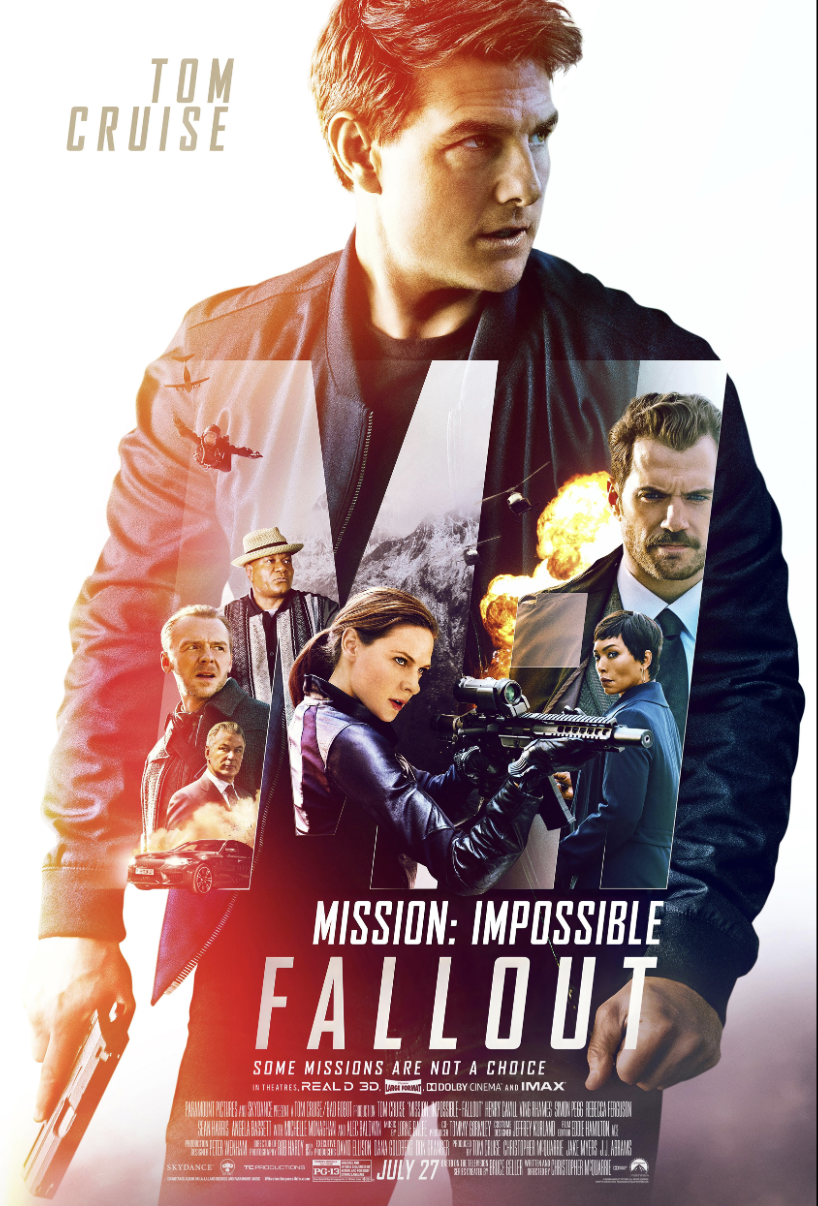
Director: Christopher McQuarrie
Writer: Christopher McQuarrie
Starring: Tom Cruise, Henry Cavill, Ving Rhames, Simon Pegg, Rebecca Ferguson, Sean Harris, Angela Bassett, Vanessa Kirby, Michelle Monaghan, Alec Baldwin
Composer: Lorne Balfe
Genre: Action, Adventure, Spy, Thriller
Runtime: 2 Hours 27 Minutes
MPAA: PG-13 for violence and intense sequences of action, and for brief strong language.
Grade: A
Synopsis: Ethan Hunt and the IMF team join forces with CIA assassin August Walker to prevent a disaster of epic proportions. Arms dealer John Lark and a group of terrorists known as the Apostles plan to use three plutonium cores for a simultaneous nuclear attack on the Vatican, Jerusalem and Mecca, Saudi Arabia. When the weapons go missing, Ethan and his crew find themselves in a desperate race against time to prevent them from falling into the wrong hands.
Review: Mission: Impossible – Fallout is the sixth installment in the Mission: Impossible franchise and follows IMF agent Ethan Hunt as a mission gone wrong forces him into a race against time to prevent a global catastrophe. Pursued by old enemies and closely watched by the CIA, Ethan must decide how far he is willing to go to protect both his team and the mission.
Action films often become so focused on spectacle that they forget to give audiences a reason to care about what is happening on screen. Mission: Impossible – Fallout succeeds because it understands that great action is built on tension, character, and consequence long before the explosions begin.
From its opening sequence, the film wastes little time reminding audiences why Ethan Hunt remains one of modern cinema's most compelling action heroes. Christopher McQuarrie establishes the stakes immediately, allowing every decision Ethan makes to feel consequential rather than simply serving as a bridge to the next action scene. While the Mission: Impossible franchise has always been known for its elaborate set pieces, Fallout is the first entry that feels equally invested in the people experiencing them.
That balance is what elevates the film beyond a typical spy thriller.
The action itself is exceptional.
Whether it's the brutal bathroom fight, the breathtaking motorcycle chase through Paris, or the now-iconic helicopter finale, every sequence feels grounded in physicality rather than computer-generated spectacle. McQuarrie consistently favors clarity over chaos, allowing the audience to understand where every character is, what they're trying to accomplish, and what is at stake if they fail.
That clarity makes every stunt more effective.
Tom Cruise's commitment to performing many of the film's practical stunts is well documented, but what makes those moments memorable is not simply that they are real. It is that the camera allows the audience to appreciate them. Rather than hiding the action behind rapid editing or excessive visual effects, McQuarrie trusts both the performers and the choreography to tell the story. The result is some of the most convincing action filmmaking in recent memory.
Just as impressive is the film's pacing.
Unlike many modern action films, Fallout never feels like it is simply waiting for the next explosion. When the action slows, the story remains engaging enough to carry the audience forward. The conflict between the IMF and the CIA creates genuine political tension, while Ethan's partnership with August Walker introduces an unpredictable dynamic that constantly keeps viewers questioning where loyalties truly lie.
Even when certain twists become apparent before they are revealed, they lose very little impact. The enjoyment comes less from discovering the twist itself and more from watching the characters slowly uncover the truth. McQuarrie understands that suspense is often more satisfying than surprise.
Technically, the film is equally accomplished.
Lorne Balfe's score injects urgency into nearly every scene without overwhelming it, while Rob Hardy's cinematography gives the film a polished but grounded visual identity. Although the cinematography occasionally leans toward conventional blockbuster framing, it never distracts from the action. Instead, it consistently serves it. Practical effects and visual effects blend together remarkably well, creating a world that feels tangible even during the film's largest set pieces.
If the film has one weakness, it lies in its second act.
While never uninteresting, the middle portion slows just enough to slightly disrupt the relentless momentum established early on. Trimming several minutes from the film would likely have strengthened its pacing. Likewise, the primary villain never receives quite enough development to become as memorable as the heroes pursuing him. Despite Sean Harris delivering another solid performance, the film often seems more interested in the mission itself than in the man behind it.
Fortunately, neither issue significantly diminishes the experience.
Ultimately, Mission: Impossible – Fallout represents the franchise at its absolute best. It combines breathtaking practical action with compelling storytelling in a way few modern blockbusters manage to achieve. Every stunt serves the narrative. Every action sequence advances the characters. Every emotional beat feels earned.
More importantly, the film understands that audiences are not invested because Ethan Hunt can survive impossible situations.
They are invested because they believe he might not.
That constant sense of danger, paired with exceptional filmmaking across nearly every department, makes Mission: Impossible – Fallout not only the strongest entry in the franchise, but one of the finest action films of the modern era.