

Buddy Analysis
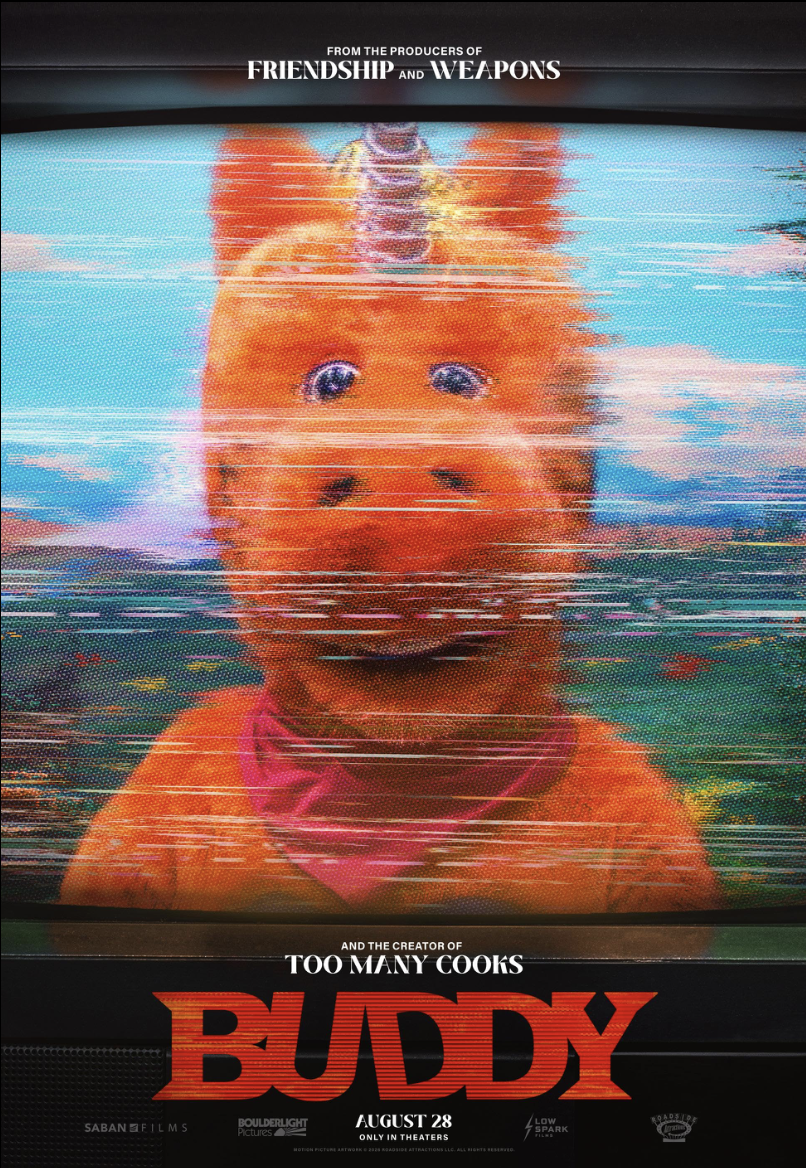
The best way I can possibly describe Buddy is simple: it is hauntingly allegorical. At first glance, Buddy is a horror comedy. It follows a group of children attempting to escape the grasp of Buddy, a sinister and deeply wicked unicorn who resembles something straight out of children's programming. He is colorful, cheerful, energetic, and immediately familiar. In many ways, Buddy feels like a twisted reflection of characters such as Barney the Dinosaur, or even the already unsettling world of Pee-wee's Playhouse, and other beloved personalities who have spent decades speaking directly into the lives of children. But beneath the comedy and horror is something far more interesting. At its deepest and most authentic level, Buddy feels like a cautionary tale about the way children engage with media and the responsibility parents have to understand what their children are consuming. Running alongside that story is a mother searching for her missing child, a thread that adds urgency without ever needing to be fully explained. Buddy's world is not simply a physical place. It represents something that has been allowed to capture children without anyone fully understanding what is happening inside. That is where the allegory becomes fully realized.
One of the most unsettling aspects of the movie is how Buddy finds his victims. He speaks directly to children through the television. He doesn't necessarily drag them into his world by force. Instead, he gains access to them through something that feels safe. Something familiar. Something colorful and entertaining. Something their parents may have assumed was harmless. And by the end of the film, we are given a truly disturbing image: children sitting in front of televisions, watching without parental supervision, as Buddy continues speaking directly into their lives. Now, I don't think the movie is arguing that allowing your child to watch television without you sitting beside them is inherently evil. I don't think that is the point. The question is much deeper than that. Do we actually know what our children are watching? Do we care about who is creating the content they consume? Do we know the people behind the characters speaking directly into their lives? Do we understand the values, worldview, and intentions behind the programming that our children may spend hours engaging with? Because the truth is that we often see something designed for children and instinctively assume that it is safe. And Buddy is deeply interested in challenging that assumption.
Perhaps one of the most brilliant things about the movie is the way it creates a space that appears completely safe on the surface. Buddy's world is bright, colorful, and vibrant. It is attractive to young minds. The conversations are gentle and seemingly wholesome. The characters talk about overcoming fears, loving one another, avoiding judgment, and not fighting or bickering. On paper, there is nothing obviously dangerous about any of this. In fact, it sounds like exactly the kind of programming parents would want their children to watch. But that is what makes it so disturbing. The danger is not immediately visible. The world only reveals its true nature when the children begin acting in ways that are contrary to what is expected of them. Suddenly, the supposedly safe environment becomes hostile. What appeared loving becomes controlling. What appeared educational becomes manipulative. And what appeared peaceful reveals itself to be deeply abusive. That is a fascinating idea. Because something does not have to look dangerous in order to be dangerous. Something can be colorful, positive, entertaining, and even speak the language of kindness while still exercising a deeply unhealthy influence over the people consuming it. And that is where Buddy becomes more than a horror movie.
I also think Buddy offers a powerful depiction of the dangers that can occur for children working on entertainment sets. In recent years, documentaries such as Quiet on Set have shed light on the harm child actors have faced in the entertainment industry. They have exposed how vulnerable children can be when they are placed in environments controlled by adults who are supposed to protect them, guide them, and provide a safe workplace. Buddy continues to point that spotlight directly at the dangers of predators on sets involving children. The film's use of literal spotlights and staged television environments makes this idea especially unsettling. The children are constantly placed in front of cameras, surrounded by colorful sets, bright lights, costumes, and adults who appear to be creating something harmless. Everything is presented as entertainment, but beneath that surface is the possibility of exploitation and abuse. That contrast feels deeply intentional. A set can look cheerful while still being unsafe. A production can be marketed as wholesome while failing to protect the children involved. An adult can appear friendly, professional, or beloved by audiences while using their position to gain access to vulnerable young performers. The danger is not always obvious because the environment has been designed to make everyone feel comfortable. That is what makes the allegory so disturbing. Buddy does not simply represent a dangerous character speaking to children through a screen. He can also be read as a symbol of the adults behind the screen: the people who create the world, control the set, direct the children, and decide what the audience is allowed to see. The children may be surrounded by cameras and adults, but that does not necessarily mean they are protected. Sometimes, the people closest to the production are the ones who pose the greatest threat.
What makes this theme even more effective is that the movie doesn't limit its warning to children alone. There is a scene between Buddy and a nurse that makes this point unmistakably clear. It is one of the more telling moments in the film precisely because a nurse is not a child. She is an adult, presumably trained, presumably capable of recognizing danger. And yet Buddy still finds a way in. That scene reframes the entire allegory. It suggests that the real target of this kind of predatory manipulation is not "children" as a category, but vulnerability itself, wherever it shows up. Children are the most obvious example because they are trusting, impressionable, and dependent on the adults around them. But a nurse occupies a similar position on a film set: she is there to care for others, often overworked, often positioned as support staff rather than a protected talent, and often the last person anyone thinks to check on. The scene works because it strips away the assumption that danger only follows innocence. It follows access and power imbalance instead. On a set, that can mean a child actor. It can just as easily mean the crew member whose job is to look after everyone else's wellbeing while no one is looking after hers. Buddy exploiting that dynamic is one of the sharpest moves the film makes, because it widens the allegory from "protect the children" to something closer to "protect whoever has the least power to protect themselves."
The cinematography and visual design of Buddy are absolutely intentional. The colors are incredibly vibrant. They are disarming. They make you feel comfortable even when you know something is wrong. From the very beginning, the director is essentially deceiving the audience in the same way that Buddy deceives the children. The film presents you with something that looks safe. Something familiar. Something that your mind recognizes from childhood. And then, slowly, it reveals what has been hiding underneath the surface. That visual strategy is one of the reasons the movie works so well as an allegory. The audience is not simply watching children be manipulated by something colorful and comforting. In a strange way, we are experiencing the same manipulation ourselves. We know Buddy is dangerous, but the world around him still feels inviting. And that tension is where much of the movie's effectiveness comes from. It also mirrors the way abuse can remain hidden within the entertainment industry. The audience sees the finished product: the bright colors, the smiling faces, the polished performances, and the supposedly joyful atmosphere. What we do not see are the private conversations, the power dynamics, the pressure placed on children, or the adults who may be taking advantage of their authority. The spotlight reveals the performance. It does not necessarily reveal the truth.
Some viewers may look at the performances and assume that the acting is intentionally poor or exaggerated. I don't think that's true at all. I think the performances are perfect. They are deliberately crafted to resemble the style of children's television. The line delivery is slow and intentional. The emotions are exaggerated. The dialogue feels dramatic in ways that would feel strange in a traditional horror film. But that's because Buddy is not trying to look like a traditional horror film all the time. It is trying to look like children's programming. And the actors understand that assignment. The over-the-top performances, exaggerated expressions, and deliberate delivery all contribute to the illusion. The movie needs you to feel like you have stepped into a world designed for children before it can effectively reveal how sinister that world truly is. The acting is not bad. It is purposefully artificial. And in a movie that is fundamentally interested in exposing the artificial nature of a supposedly safe world, that choice feels incredibly appropriate. It also reinforces the film's commentary on child performers. The children are expected to perform happiness, fear, obedience, and enthusiasm on command. They are placed inside a manufactured world and asked to behave as though everything is safe. That performance becomes even more disturbing when we recognize how easily adults can hide danger behind the language of entertainment.
Buddy is not great because it is the scariest horror movie you will ever see. It is not even great because of traditional horror. It is great because of what it does after the credits begin rolling. It opens a can of worms. It forces us to look deeper. It asks difficult questions about the things we allow into the lives of our children. It challenges us to consider whether we should be more aware of children's programming and more concerned about the people creating the content our children consume. It also asks us to think about the environments in which children, and other vulnerable people, are expected to perform. Who is speaking to our kids? What are they teaching them? What kind of influence are they exercising? Who is responsible for protecting the most vulnerable people on entertainment sets, whether that's a child actor or the nurse standing off to the side? What happens when the adults who are supposed to keep them safe are the ones abusing their power? And perhaps most importantly, how often do we assume something is safe simply because it was designed to look safe? That is what makes Buddy such an interesting film. Beneath its horror-comedy exterior is a genuinely unsettling allegory about childhood, media, manipulation, trust, and the entertainment industry. It understands that the most dangerous things are not always the things that announce themselves as dangerous. Sometimes they are colorful. Sometimes they are cheerful. Sometimes they tell you that they love you. Sometimes they stand beneath bright lights and perform for an audience. And sometimes, they are speaking directly to your children, or to whoever else happens to be the most vulnerable person in the room, through the television. That is why the best way I can describe Buddy is this: it is hauntingly allegorical.