

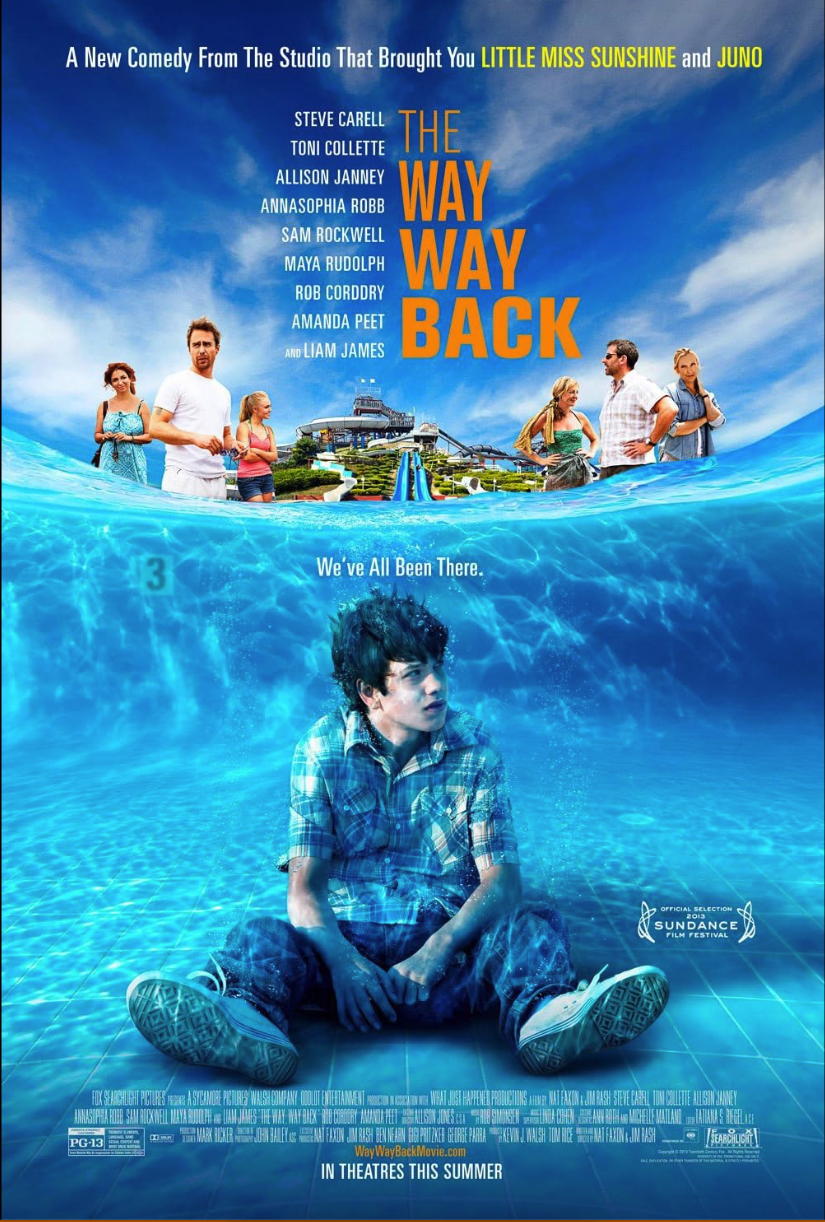
Director: Nat Faxon, Jim Rash
Writer: Nat Faxon, Jim Rash
Starring: Liam James, Steve Carell, Toni Collette, Sam Rockwell, AnnaSophia Robb, Allison Janney, Maya Rudolph, Amanda Peet, Rob Corddry
Composer: Rob Simonsen
Genre: Comedy, Drama
Runtime: 1 Hour 43 Minutes
MPAA: PG-13 for thematic elements, some sexual content, language, and teen partying.
Grade: A+
Synopsis:
The Way, Way Back follows Duncan, a shy fourteen-year-old who reluctantly spends the summer vacation with his mother, her overbearing boyfriend, and his boyfriend's daughter. After finding an unlikely refuge at a local water park, Duncan forms an unexpected friendship with its carefree manager, Owen, whose encouragement begins to change the way Duncan sees both himself and the world around him.
Review:
Coming-of-age stories often ask what kind of adult a young person will become. The Way, Way Back asks a far more important question: Who teaches them what kind of adult they should be?
On the surface, the film is about a boy who spends one unforgettable summer working at a water park. It is funny, heartfelt, and effortlessly charming. Yet beneath that deceptively simple premise lies a thoughtful examination of mentorship, self-worth, and the people who shape us.
At its heart, The Way, Way Back is the story of two men competing for the future of one boy.
One believes people earn their worth.
The other believes they already have it.
Everything else is simply the battleground.
Owen is one of cinema's most compelling mentors, not because he delivers inspirational speeches or possesses extraordinary wisdom, but because he simply believes in people. He never measures someone's value by popularity, confidence, or reputation. Instead, he instinctively sees the good in people who struggle to see it in themselves. Duncan never has to earn Owen's respect. He has it from the moment they meet.
That is what makes Owen such a remarkable character.
He demonstrates that being a genuinely good person costs nothing. He asks for very little in return, choosing instead to invest in the lives of those around him simply because they need someone willing to do so. Sam Rockwell gives a performance filled with warmth, humor, and authenticity, creating a character who feels less like an idealized mentor and more like someone we have all hoped to encounter at least once in our lives. It is difficult to watch Owen without wanting to become a little more like him.
Standing opposite Owen is Trent, one of the film's greatest strengths.
Trent never sees himself as the antagonist. He believes he is offering discipline, motivation, and direction. His tragedy is that his self-righteousness blinds him to the damage he causes. His idea of perfection is himself, and every relationship around him suffers because of it. Steve Carell resists turning Trent into a caricature, instead portraying a man whose confidence quietly becomes emotional manipulation. The result is a villain who feels believable precisely because he never recognizes the harm he causes.
That contrast is what elevates the film.
Duncan is not simply choosing between two father figures. He is choosing between two entirely different views of humanity. Owen teaches that people possess value before they accomplish anything. Trent believes value must be earned through performance and approval. Their conflict extends far beyond Duncan himself. It becomes a battle over the kind of man he will ultimately become.
The screenplay understands this beautifully.
Every joke, every awkward interaction, and every heartfelt conversation quietly builds toward Duncan's transformation without ever feeling manipulative. The dialogue reveals character naturally, allowing the audience to understand who these people are through the way they interact rather than through exposition. Even the film's funniest moments carry emotional weight, making the ending feel inevitable instead of manufactured.
The supporting cast is equally strong. Toni Collette brings heartbreaking vulnerability to Duncan's mother, portraying a woman who slowly realizes the cost of settling for someone who diminishes both her and her son. Allison Janney provides many of the film's biggest laughs without ever feeling disconnected from its emotional core, while the ensemble creates a world that feels lived in rather than written.
The film's emotional payoff is equally impressive.
Without resorting to melodrama or manufactured sentimentality, The Way, Way Back earns every emotional beat through the relationships it has spent the entire film developing. Duncan's growth never feels rushed or unrealistic because the screenplay understands that confidence is not discovered overnight. It is built slowly through trust, encouragement, and the quiet influence of people willing to believe in us before we believe in ourselves.
There are movies that entertain us. There are movies that impress us. Then there are movies that quietly change the way we see the world.
The Way, Way Back did exactly that for me. It deepened my love for film by reminding me that cinema's greatest strength is not spectacle, but its ability to reveal timeless truths about what it means to be human. It remains one of the finest screenplays I have ever encountered, not because it tells an extraordinary story, but because it tells an ordinary one with extraordinary honesty. Every time I revisit it, I leave wanting to be a little more like Owen. Few films have had a greater impact on how I think about people, and even fewer have reminded me so powerfully that believing in someone can change the course of their life.
Final Grade: A+