

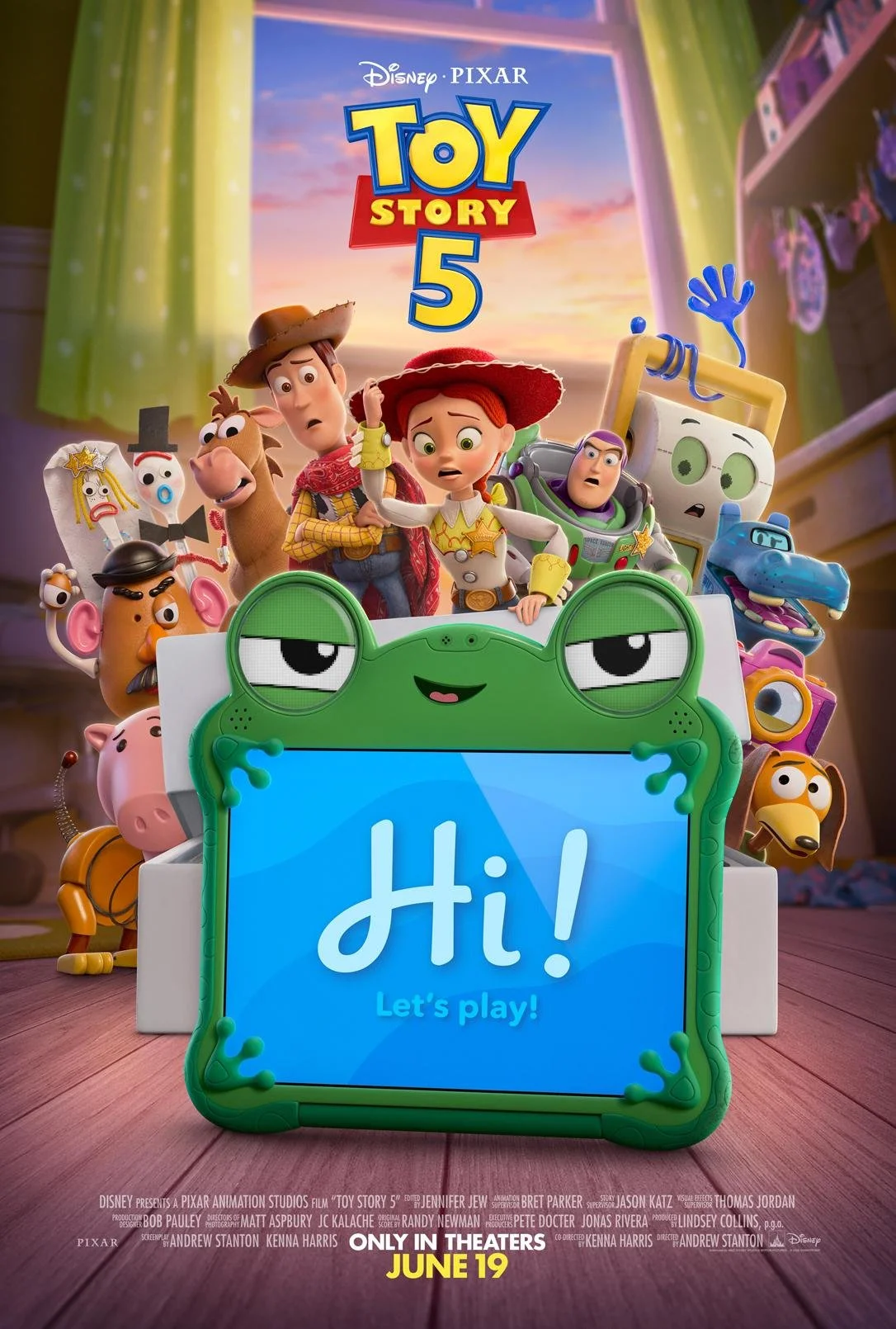
Toy Story 5
Director: Andrew Stanton
Co-Director: McKenna Harris
Writers: Andrew Stanton, McKenna Harris (Story by Andrew Stanton)
Starring: Tom Hanks, Tim Allen, Joan Cusack, Greta Lee, Conan O'Brien, Tony Hale, Ernie Hudson, Annie Potts, Bonnie Hunt, Wallace Shawn, John Ratzenberger, Blake Clark
Composer: Randy Newman
Genre: Adventure, Animation, Comedy, Kids & Family
Runtime: 1 Hour 42 Minutes
Synopsis: Buzz, Woody, Jessie and the rest of the gang come face-to-face with Lilypad, a brand-new tablet device that arrives with her own disruptive ideas about what is best for Bonnie. Will playtime ever be the same?
Review:
On the surface, Toy Story 5 is a simple but entertaining film. It is compelling enough to hold your attention throughout its 102-minute runtime, delivering plenty of laughs, heartfelt moments, and enough nostalgia to satisfy longtime fans. However, it is also easily the weakest entry in the franchise.
That does not make it a bad movie.
It simply misses what made Toy Story special in the first place.
For nearly thirty years, Toy Story has never truly been about toys. The adventures were fun, but they were always secondary to the emotional journeys of the characters. Woody's jealousy, Buzz's identity crisis, Jessie's fear of abandonment, and the franchise's recurring themes of purpose, change, and letting go have always been the heart of the series.
Toy Story 5 understands those themes.
The problem is that it struggles to bring them to life through its characters.
One of the film's biggest challenges is its handling of the characters themselves. Woody, while still present, feels like a shell of the character audiences have followed for decades. His role is surprisingly limited, and much of the emotional depth that once defined him is missing. Buzz Lightyear fares even worse. Rather than feeling like a continuation of the character we have watched grow across four films, he often feels like a simplified version of who he used to be.
Much of the film instead focuses on Jessie, which gives Toy Story 5 a noticeably different feel than the previous movies. To be fair, Jessie is at the center of what should have been the film's strongest storyline. Her struggle to accept that children grow up and eventually move on is exactly the kind of emotionally mature theme that Toy Story has always done well.
Unfortunately, Jessie rarely feels as conflicted as the film wants her to be. The best Toy Story movies succeed because their characters wrestle with difficult choices and painful truths. Woody's greatest moments came from watching him struggle between what he wanted and what he knew was right. Jessie, by comparison, often comes across as frustrated or angry rather than genuinely conflicted. The theme is there, but the emotional depth needed to make it truly resonate often is not.
To the film's credit, there are still moments where it shines. It can be both heartbreaking and heartwarming, and many of its laughs feel genuinely earned. When Toy Story 5 works, it works because it reminds audiences why they fell in love with these characters in the first place.
The film is also visually impressive. Some of the new artistic choices are genuinely creative, particularly the way it shows what "play" feels like from the toys' perspective. These scenes are among the strongest in the movie and offer a fresh look at an idea that has existed since the very beginning of the franchise.
Unfortunately, those moments are often overshadowed by the film's larger storytelling problems.
The story tries to balance three separate plotlines at once, resulting in uneven pacing and a narrative that often feels disconnected. For much of the movie, it can feel less like one adventure and more like three separate stories happening at the same time until they finally come together near the end.
More importantly, the film spends so much time moving between those stories that it rarely slows down long enough to explore what any of it means for the characters. Previous Toy Story films used their plots to reveal something deeper about the people at the center of them. Here, the plot often feels like the main focus, while the character development struggles to keep up.
This is especially frustrating because the film's most interesting ideas are often buried beneath everything else. Jessie's story should be the emotional center of the movie, yet it frequently feels overshadowed by technological conflicts, side plots, and constant callbacks to earlier films. The movie repeatedly pulls attention away from the very story that feels most like Toy Story.
The film also leans heavily on nostalgia. Rather than creating new emotional moments that can stand alongside the franchise's best scenes, Toy Story 5 often asks audiences to remember older ones. Longtime fans will appreciate the references, but many of the movie's biggest emotional moments feel borrowed rather than earned.
Some of the humor has a similar problem. Previous Toy Story films found comedy through character and circumstance. Here, several jokes feel disconnected from the characters themselves. A balding, overweight Woody is repeatedly used as a visual gag, while another scene portrays a toy with a failing battery in a way that strongly resembles intoxication. While the moment is clearly intended as comedy, it felt awkward and out of place in a Toy Story film.
There are also moments where the movie asks audiences to suspend an unusual amount of disbelief. While Toy Story has never been concerned with realism, it is a series about living toys after all, the technology driving parts of the plot often feels written by people whose understanding of Wi-Fi and messaging systems begins and ends with "the internet does magic things." It is hardly the film's biggest problem, but it can be distracting.
That is ultimately what separates Toy Story 5 from the films that came before it.
The issue is not that the movie is poorly made. It is funny, charming, visually impressive, and often enjoyable. In many ways, it contains all the ingredients of a great Toy Story film. The themes are there. The characters are there. The humor, heart, adventure, and emotional moments are all present.
Yet something feels off.
The ingredients are all there. They are simply mixed in the wrong proportions.
Previous Toy Story films used their adventures to deepen our understanding of their characters. Toy Story 5 often does the opposite. The emotional story exists, but it is frequently buried beneath competing plotlines, technological conflicts, nostalgia callbacks, and broader comedy.
The result is a film that understands what Toy Story is about, but never seems confident enough to slow down and explore it.
Toy Story has always been a series driven by character. The adventures mattered because the characters mattered.
Toy Story 5 attempts to tell a story about growing up, letting go, and accepting change through Jessie. Those ideas are undeniably Toy Story.
The problem is that the movie never gives them enough room to breathe.
Instead, it delivers a competent, entertaining, and occasionally moving adventure that never fully captures the emotional soul of the franchise.
Overall, Toy Story 5 isn't a bad movie.
It's just not a particularly good Toy Story movie.